How to measure a bedroom for a bed
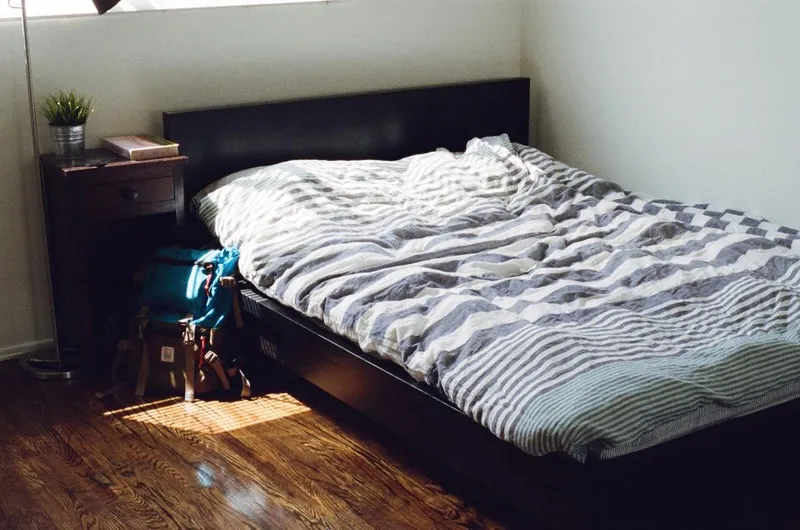
Most people ask “will a queen fit?” The question that decides it is a different one. Will the frame fit, and can you still get out of bed?
The mattress is not the bed
A queen mattress is 60 inches wide. The bed it sits on is not.
Rails run down each side. A headboard is often wider than the mattress. A storage base with drawers has to clear the mattress so the drawers can open. A padded or upholstered frame adds the padding on top of all that.
Two inches a side is normal. Four is common on storage beds. That turns a 60 inch queen into a 64 or 68 inch object. In a small room those inches come straight out of the space you walk in.
So measure the frame, not the mattress. If you already own the bed, put a tape on the floor beside the rail and push it under the mattress until it stops. That one number, for one side, is what to plan with. If you are buying, the maker’s spec sheet usually lists the outside width somewhere below the mattress size.
What are the sizes, and can you trust them?
These are the figures the US trade normally quotes, in inches:
| Size | Mattress |
|---|---|
| Twin | 38 × 75 |
| Twin XL | 38 × 80 |
| Full (double) | 54 × 75 |
| Queen | 60 × 80 |
| King | 76 × 80 |
| California king | 72 × 84 |
They are a convention, not a standard set by one authority. Makers vary, often by about an inch. Treat the table as a starting point and check the spec for the bed you are actually buying.
Two things in that table catch people out. A king is not longer than a queen. It is 16 inches wider and exactly as long. And a California king is narrower than a king, not wider.
It trades four inches of width for four inches of length. That helps a tall sleeper in a long room, and hurts in a wide short one.
How much space do you need around it?
There is no legal or official figure for the gap beside a bed. What gets quoted is 24 to 30 inches, and it is a working convention rather than a rule. For a main route through a room, 36 inches is the usual target.
What those numbers buy you:
- Under about 18 inches you turn sideways to get past, and making the bed from that side is awkward.
- Around 24 inches you can walk down the side and open a nightstand drawer.
- 30 to 36 inches you can strip the bed without climbing on it, and two people can pass.
The head of the bed needs nothing. A headboard against a wall is how beds are meant to sit, so that side costs you no floor at all.
The foot is where people are most willing to compromise. If nobody walks past the end, a foot of space is fine. If the route from the door to the closet goes that way, you want the full 36 inches.
Measure the room, not the carpet
Measure wall to wall at floor level, in both directions. Then walk the room and note anything that eats into it:
- A door, and which way it swings. An open door sweeps a quarter circle of floor as wide as the door leaf, usually 28 to 32 inches.
- A closet, and the floor you need in front of it to open the doors and stand there.
- A radiator, a baseboard heater, or a window you want to be able to open.
- A dresser, which needs its drawers to open fully.
A bed that lands in the door swing is not a tight fit. It is a bed that stops the door opening, and no amount of clearance elsewhere fixes it.
What if it is an inch too wide?
Before you drop a size, try these:
Turn the bed. A bed with its head on a different wall can change everything in a room that is much longer than it is wide.
Drop one nightstand. A pair of nightstands can add 40 inches across a room. One nightstand, or a wall shelf on the other side, gives that back.
Put one side against the wall. If one person sleeps there, only one side has to be usable. The calculator has a setting for it.
Change the frame, not the mattress. A platform frame with no overhang keeps the mattress you wanted and gives back four to eight inches.
Check it on a plan
The bed size room fit calculator puts your room on screen to scale. Drag the bed, the nightstands and the door swing around until the layout looks like yours. It tells you the gap at each side as you move.
It also walks the standard sizes from king down and names the biggest one that still works where your bed is sitting.